
Category Archives: Film

Interview: Filmmaker Jason Hall talks ‘Thank You for Your Service’

As Veterans Day fast approaches, a new film that examines the true-life plight of soldiers returning home from the Iraq War is about to open in theaters — and thankfully for moviegoers and most importantly, veteran viewers, “Thank You for Your Service” was completed under the watchful eye of filmmaker Jason Hall.

Hall, who was nominated for a Best Adapted Screenplay Oscar for adapting late Navy SEAL Chris Kyle’s novel “American Sniper” for the big screen in 2014, adapted the screenplay of David Finkel’s book “Thank You for Your Service,” and was also handed the director’s reigns for the project by Steven Spielberg. Considering that Spielberg first intended to direct the film himself, installing Hall at the helm of the gut-wrenching drama says a lot about the legendary filmmaker’s confidence in the first-time director.

Clearly Spielberg knew through his development of the screenplays of both “American Sniper” (which Clint Eastwood directed) and “Thank You for Your Service” that Hall had keen insight into the struggles of veterans trying to re-adjust to civilian life back home after the service,  and specifically relating to the latter, how under-equipped the U.S. government is to meet the mental health needs of its solders.

“The thing I learned with Chris Kyle was that even the heroes are carrying this home. And while it’s one in five or one in four that come home with some version of trauma, the services we provide just aren’t enough,” Hall said in a recent phone conversation from Los Angeles. “As for ‘Thank You for Your Service,’ the depiction of what David Finkel did in the book was so frustratingly harrowing to me. I just couldn’t believe it, so I started looking into it.”

Opening in theaters nationwide on Friday, “Thank You for Your Service” tells the compelling true-life story of Army Staff Sgt. Adam Schumann (Miles Teller), who returns home along with two fellow solider friends from the Iraq War, only to soon discover that none of them can handle the prolonged effects of war and a specific combat tragedy that changed all of their lives.
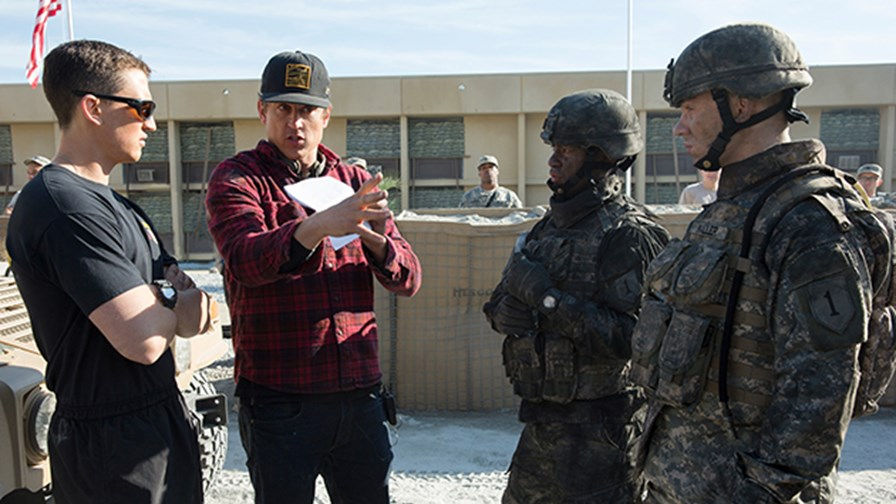
Photo: Universal Pictures
Writer-director Jason Hall on the set of ‘Thank You for Your Service’

Hall said Finkel’s book came to him while he was adapting the screenplay for “American Sniper” for director Spielberg, who eventually handed the project over to his fellow filmmaker Clint Eastwood. So, by the time “American Sniper” hit theaters, Hall said he started talking with VA psychologists and started visiting VA hospitals around LA, while consulting former Secretary of Veterans Affairs Bob McDonald as well.

While some may want to classify “Thank You for Your Service” as a war film, Hall — whose grandfather, uncle and half-brother all served in the military — said it’s not so much a war film as it is a film about how soldiers deal with the effects of war.

“I think the effects of war are a battle of their own, in as much as the war continues to echo in, around and in front of these veterans,” Hall said. “It wounded them, and it continues to inflict them. So, for me, it was about finding a way to bring the immediacy of those moments to the film and examine what happens in the ‘after war.’ That’s what David Finkel calls it in his book — the ‘after war.’ There are depictions in this movie of life or death right here in America, on the home front, that we wouldn’t normally consider to be the battlefield.”

While we discover how stressed Veterans Affairs is in trying to handle the influx of thousands of soldiers returning home with posttraumatic stress disorder (PTSD) in “Thank You for Your Service,” Hall said the point of the movie isn’t to pin blame on one entity.

“While the services are faulty, the reality is, the VA is still the best place for soldiers to go for trauma and for help,” Hall said. “You can’t do ChoiceCare and go to your doctor in Beverly Hills and tell him you saw some things in the war that are really troubling you. He’s not going to know what to do with that. So, as bad as it is, it’s what we got to work with and we have to find a way to make it work.”

So, while the government may be an easy scapegoat when it comes to meeting soldiers’ mental health needs — yet there’s no denying they are woefully understaffed to handle the immense caseload — Hall said the solution is up to us to rally for change to the flawed system and culture for a one that the soldiers deserve , especially given the amount of sacrifice they’ve made for our country.

“At a certain point it’s up to us. At a certain point it’s up to society to find a welcome these guys back in, because it’s not just the VA,” Hall said. “Some of what we see is dictated by the way they are welcomed back into society and the way that we perceive them — not only as heroes, but as wounded.”

Sometimes, Hall said, soldiers have been affected by war in ways most people wouldn’t expect.

“Some of these guys don’t even get out of the armory and they’re messed up by the institutionalization by the enterprise of war, or the repetitive nature of firing all these rounds, with something thrust against your cheekbone in a way that it disturbs your brain” Hall said.  “There’s a lot that goes into this that we don’t fully comprehend, and certainly the VA and military didn’t comprehend going into the war or what they were going to have to deal with when these guys came home.”

Naturally, Hall depended on Schumann as much as he could to get the details of his story right, and is thankful that the veteran was willing to open himself up to reveal some very painful chapters in his life.

“To have Adam around, to have someone around as your source of all of this, to be so emotionally accessible and so emotionally articulate was so helpful,” Hall said. “Adam was there at the starting line. This guy was heroic in battle, but then he came home and did something equally or more heroic in revealing himself — not only with what he experienced in the war, but what he continued to experience because of what he had seen, done, gone through and lost over there.

“To me that was the most heroic thing that anyone could have done in that entire war — to come home and reveal themselves, which is not something you’re trained to do,” Hall added. “Adam took it upon himself to do that because he knew it was going to help somebody else.”

Copyright 2017 DirectConversations.com
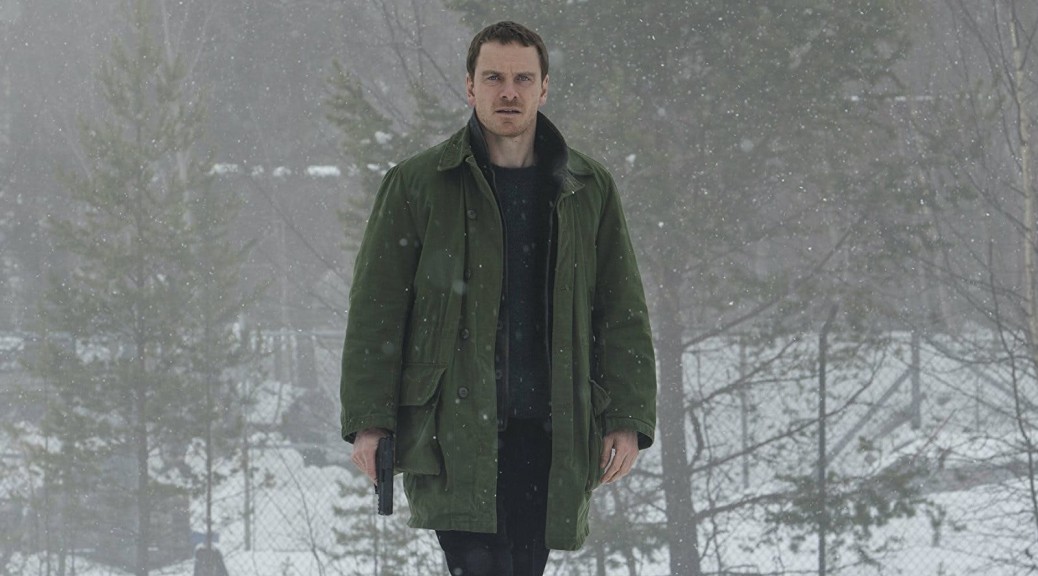
Movie review: Muddled, depressing ‘Snowman’ caught in blizzard of dreariness

The Snowman (R)

Michael Fassbender gets trapped in a depressing blizzard of dreariness that he can’t escape in “The Snowman,” a deeply disappointing and depressing crime thriller from executive producer Martin Scorsese and director Tomas Alfredson (“Tinker Tailor Solider Spy”).

Based on the acclaimed novel by Jo Neso, Fassbender plays grizzled Norwegian detective Harry Hole, whose interest in a decades-old cold case murder and dismemberment of a woman is reawakened by the killer’s re-emergence and brutal killing spree.

AUDIO: Listen to Tim review “The Snowman” with Tom Barnard on “The KQ92 Morning Show” (segment begins 10 minutes in).

While the film’s Oslo setting is breathtaking, “The Snowman” fails to gain any sort of momentum from the very beginning, and quickly devolves from there into a dull and confusing story that fails to get its footing until the film’s predictable conclusion.

Scorsese, who was at one time attached to the direct the film, wisely stepped away from this disaster of a movie, which is so bad that even the talents of Fassbender, Rebecca Ferguson, J.K. Simmons and Val Kilmer can’t save it. You can’t entirely blame Alfredson for the failure of the film, as he recently tried to distance himself from the film by saying that he didn’t have enough time on the production to shoot 10 to 15 percent of the script.

With revelations like that, there’s no doubt that “The Snowman” was doomed to fail, and the memories of this stained mark on the resume of all those involved can’t melt and wash away soon enough.

Lammometer: 3 (out of 10)

Copyright 2017 DirectConversations.com

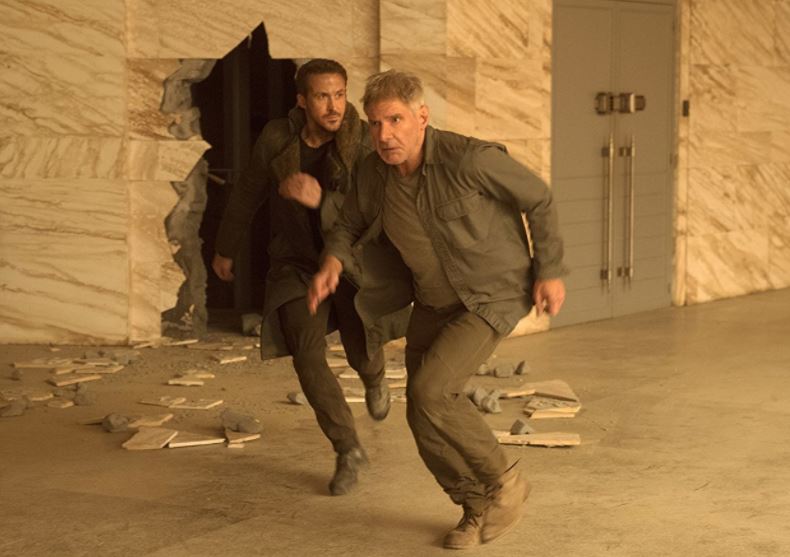
Movie review: ‘Blade Runner 2049’ fully realizes original’s potential

“Blade Runner 2049” (R)

Director Denis Villeneuve (“Arrival”) fully realizes and masterfully completes “Blade Runner” helmer Ridley Scott’s vision in “Blade Runner 2049,” an awe-inspiring sequel that’s far superior to the 1982 cult classic. Bringing original “Blade Runner” star Harrison Ford back into the fold as well as others from the original film, Villeneuve has achieved the seemingly impossible task of not only achieving the same tone of the original film, but fleshing the story out to meet its full potential.

Picking up 30 years later in a dystopian Los Angeles (LA was already in a state of polluted dreariness in 2019 in the original), “Blade Runner 2049” is populated by more replicants than ever before, which, unlike the original models, have been programmed not to revolt and are as human as they’ve ever been with an open-ended lifespan. Still, there are renegade models that have achieved what is deemed a “miracle” that threatens to upend the humans’ new world order over their synthetic counterparts, so Blade Runner Agent K is dispatched to retire the replicants involved to quell the threat. However, as K embarks on his mission, he discovers a relic that pulls him into a mysterious labyrinth that forces him to question which side he should be aligning himself with.

Warner Bros.

The fascinating thing about “Blade Runner 2049” is that Villeneuve clearly isn’t out to reinvent the wheel with the film and make it his own, as much as he’s dedicated to completing the open-ended narrative that Scott created with the 1982 film. While there have been advancements in replicant technology in the 30 years since the original, LA remains virtually the same rain-drenched, dreary environment that provided the original with its most distinct vista.

True, Villeneuve does expand the landscape a bit to give “Blade Runner 2049” some light, but even then, the new locales completely fit within the world Scott created 35 years ago. Villeneuve even went so far to scrap the score created for the film by his longtime collaborator Jóhann Jóhannsson to bring about Hans Zimmer and Benjamin Wallfisch to make it sound more like the original.

While spectacular on every level from a filmmaking standpoint, “Blade Runner 2049” has a few missteps, not necessarily with the film itself, but with the expectations it sets up for its audience. Ford is billed as a lead opposite Gosling, yet doesn’t show up until 1 hour and 45 minutes into the 2 hours and 44-minute picture; while a couple other principal characters have far-less screen time that fans have been led to believe.

Don’t expect more of anybody to show up in a future version of the Blade Runner 2049, though, as Villeneuve, unlike Scott (who has five cuts of the original) has said this is his final director’s cut. The cast is stellar across the board, including Robin Wright, Jared Leto, Dave Bautista, Ana  de Armas, Edward James Olmos, David Dastmalchian and Wood Harris. Sylvia Hoeks, a native of the Netherlands, is a particularly a standout as an replicant enforcer.

Lammometer: 9 (out of 10)

Copyright 2017 Direct Conversations.com

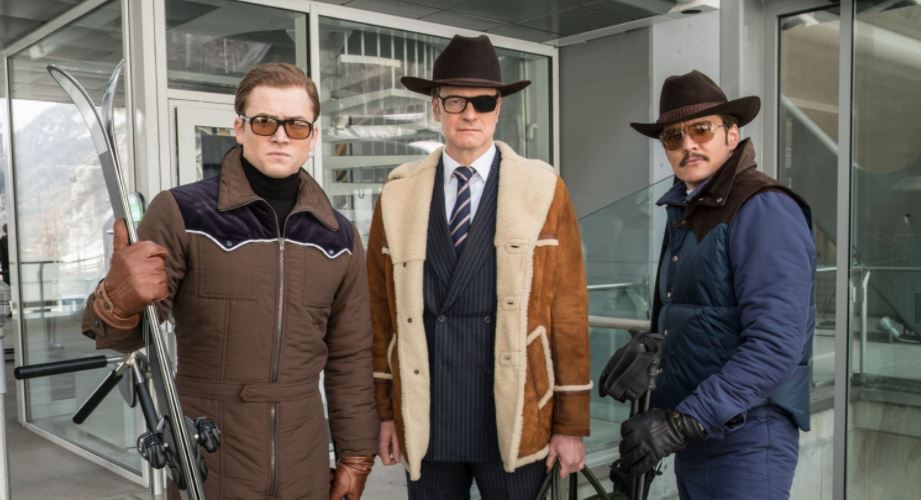
Movie review: ‘Kingsman: The Golden Circle’

“Kingsman: The Golden Circle” (R)
Taron Egerton and Colin Firth are back but with less-impressive results in ‘Kingsman: The Golden Circle,” another James Bond-on-steroids-type of tale following the out-of-nowhere success of “Kingsman: The Secret Service” in 2014. Skillfully adapted from the hit “Kingsman” comic book, the first “Kingsman” big screen adventure felt completely fresh and unexpected, while “The Golden Circle,” while entertaining, just doesn’t seem to possess the pizazz of the original.

Egerton is back as Gary “Eggsy” Unwin, a street-smart punk who was recruited in the independent intelligence organization The Kingsman to become a superspy. But since his mentor, Harry Hart  (Firth), seemingly met his fate during “The Secret Service,” Eggsy had to quickly assume the mantle and code name (Galahad) left vacant by his superior, and complete new missions with his faithful support tech, Merlin (Mark Strong).

This time around, Eggsy and his fellow Kingsman are caught in the crosshairs of Poppy (Julianne Moore), the world’s most-powerful drug cartel boss who wants recognition for the illegal industry that she’s come to dominate. After Poppy virtually eliminates The Kingsman organization in one-fell-swoop, Eggsy and Merlin enact the organization’s “Doomsday protocol,” which leads them to America and the Statesmen – the U.S. version of the Kingsman – to uncover Poppy’s location and her deadly plan to change forever the U.S. war on drugs.

It’s evident from the very first scene that “The Golden Circle,” directed by “The Secret Service” helmer Matthew Vaughn, is going to employ the same, hyper-kinetic brand of filmmaking that made the first film such a blast. But in between, the story seems to stretch itself too thin and lulls as it introduces several new characters, namely the Statesmen – including Jeff Bridges, Channing Tatum, Pablo Pascal and Halle Berry – to the fold.
While the film bills an impressive list of stars for the film, Moore, Berry and Pascal get the most screen time and make the best of it, while Bridges and Tatum are reduced to a handful of scenes.

Perhaps the biggest surprise is Elton John playing himself, kidnapped by Poppy as sort of a pet rocker whose sole purpose is to entertain the off-kilter criminal. He’s funny in every scene he appears in, and (via the help of stuntmen, naturally) has some action moves, to boot. Like “The Secret Service,” there’s no doubt inspired moments like Sir Elton’s in “The Golden Circle,” just not enough of them to justify the film’s overlong 2-hour 20-minute run-time.

Lammometer: 7 (out of 10)

Copyright 2017 DirectConversations.com.

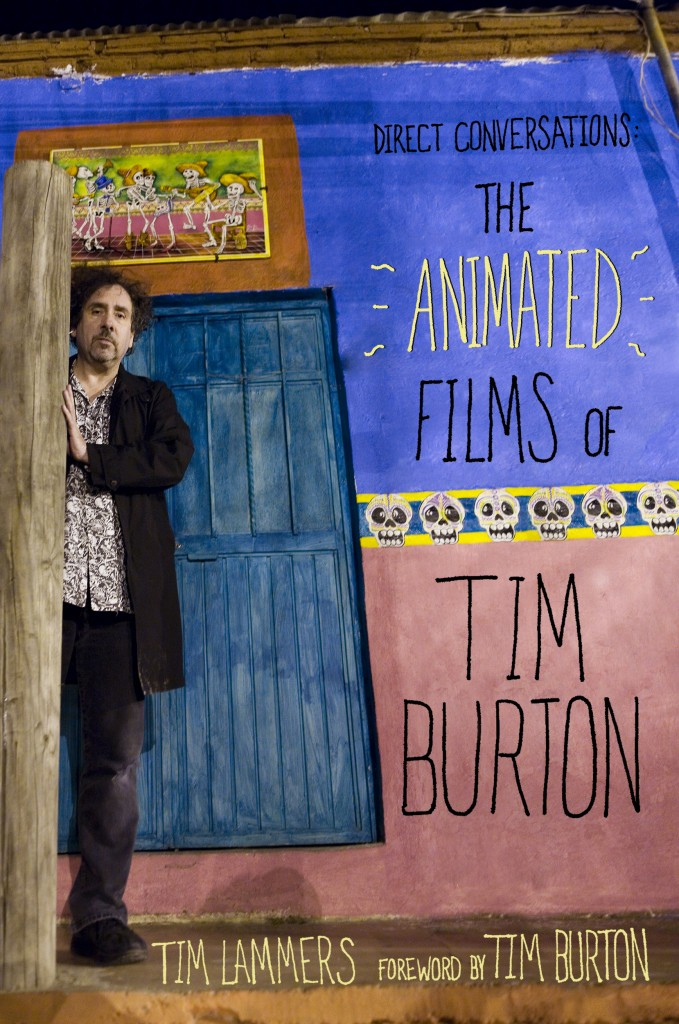
Tim Burton Book 2
Click book cover for info on how to buy!